City of Stories
The Sculptural World of Asim Basu
“A city is remembered not only through its monuments, but through the people who inhabit its streets.”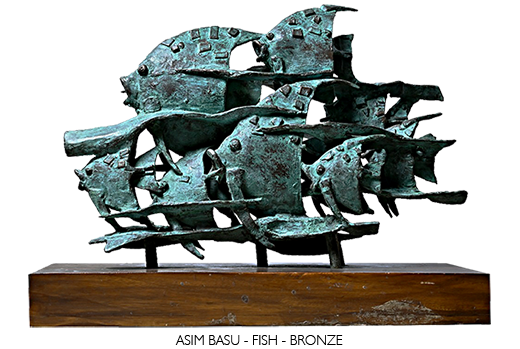 Most cities are documented through architecture, maps, photographs and history books. Yet the true identity of a city lies elsewhere—in its ordinary inhabitants, their daily rituals, shared conversations, quiet relationships and fleeting encounters. It is these seemingly insignificant moments that give a city its character and transform physical space into lived experience.
For more than four decades, Asim Basu (b. 1947) has dedicated his sculptural practice to preserving precisely these moments. Rather than seeking inspiration in mythology, political leaders or monumental public events, Basu has consistently turned his attention towards the everyday life of Kolkata. His sculptures are populated by musicians, newspaper readers, lovers, workers, children, cyclists, elderly couples, street vendors and even wandering animals—figures whose presence often escapes history but collectively defines the cultural memory of a city.
In many ways, Basu may be described as a visual storyteller. His sculptures are less concerned with portraiture than with narrative. Every work suggests an unfolding episode. A violinist absorbed in music. Neighbours debating the morning newspaper during a para adda. Two figures sharing a quiet conversation. A family cycling through the city. Fish swimming as if carried by invisible currents. Lovers sheltering beneath the rain. A mother nurturing her child. None of these works attempts to dramatise everyday life; instead, they reveal its quiet poetry.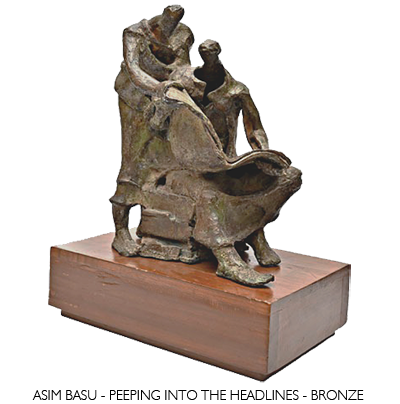
Unlike documentary realism, Basu’s sculpture is built upon suggestion rather than description. Faces are often simplified or omitted altogether. Anatomical detail yields to expressive form. Elongated bodies, gently abstracted volumes and carefully balanced compositions encourage viewers to recognise universal human experiences rather than specific individuals. Identity emerges through gesture, posture and movement rather than facial likeness.
This approach places Basu within a distinguished tradition of modern Indian sculpture that values emotional resonance over literal representation. Yet his artistic language remains distinctly his own. His figures possess an architectural solidity while simultaneously appearing light and fluid, almost as though shaped by memory rather than observation. Empty spaces become as significant as solid mass, allowing air and light to participate in the sculptural composition. Bronze, in his hands, ceases to feel heavy; it acquires rhythm, movement and intimacy.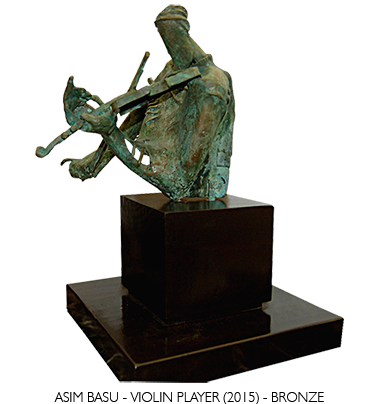
One of the defining characteristics of Basu’s work is his extraordinary ability to transform familiar urban experiences into enduring metaphors. A cyclist becomes a symbol of companionship and shared journeys. A violinist embodies the unseen cultural life of the city. Fish, recurring throughout his oeuvre, suggest both livelihood and the inseparable relationship between Bengal’s people and water. The para adda becomes more than a neighbourhood gathering—it represents democratic conversation, collective memory and the social fabric of Kolkata itself.
Equally significant is Basu’s treatment of scale. Many of his sculptures are modest in size, inviting close viewing rather than overwhelming the spectator. Their intimacy mirrors the subjects they depict. These are not monuments demanding admiration from a distance; they are conversations waiting to be discovered. As viewers move around each sculpture, new relationships emerge between figures, spaces and gestures, revealing narratives that continue beyond the boundaries of the bronze itself.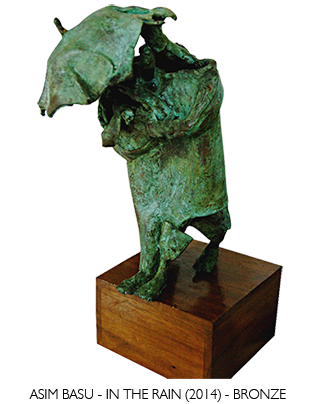
Although Basu’s practice is rooted in Kolkata, its appeal extends far beyond the city. Themes of companionship, ageing, labour, music, childhood, migration, dignity and resilience possess universal relevance. His sculptures remind us that the most profound stories are often found in ordinary lives. In an age increasingly dominated by spectacle, Basu invites us to slow down and observe the unnoticed beauty embedded within everyday existence.
Technically, his command of bronze is equally compelling. Surfaces remain alive with evidence of modelling, preserving the immediacy of the artist’s hand. Textures absorb and reflect light differently across each form, creating constantly shifting visual experiences. Structural clarity coexists with expressive freedom, while abstraction never distances the viewer from emotional engagement.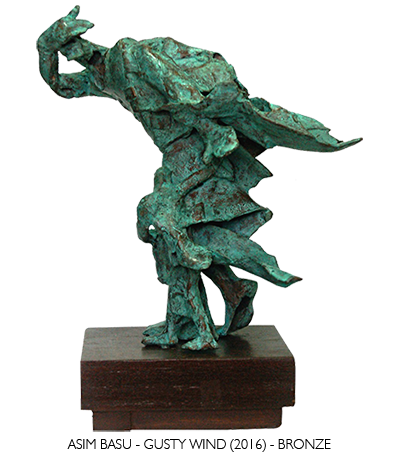
The sculptures illustrated in this exhibition reveal the remarkable breadth of Basu’s visual vocabulary. The violinist, caught in the rhythm of performance, transforms music into sculptural movement. The swirling figure seems almost lifted by the force of the wind, suggesting motion rather than stillness. The clustered fish create an intricate interplay of positive and negative space, balancing abstraction with recognisable form. Family groups evoke intimacy without sentimentality, while cyclists become quiet metaphors for partnership, balance and shared direction. Even the humble neighbourhood adda is elevated into a meditation on dialogue, community and belonging.
Collectively, these works form something greater than an exhibition of sculpture. They become an archive of urban memory. As Kolkata continues to change under the pressures of rapid urbanisation, many of the social interactions that once defined its identity are gradually disappearing. Basu’s sculptures preserve these fragile memories—not nostalgically, but with remarkable empathy and humanity.
In this sense, Asim Basu occupies a unique position within contemporary Indian sculpture. He is neither a chronicler of monuments nor a sculptor of heroic narratives. Instead, he is a chronicler of ordinary life. His true subject is not the city itself but the countless human stories that unfold within it.
City of Stories therefore presents more than four decades of sculptural practice devoted to understanding the human spirit through the life of a city. It reminds us that history is not created only by extraordinary events. It is equally shaped by everyday conversations, music heard from distant windows, shared bicycle rides, children at play, workers returning home and neighbours gathering beneath old trees.
Through bronze, Asim Basu transforms these passing moments into enduring memory. His sculptures become not only works of art but also repositories of collective experience—gentle reminders that the soul of a city resides in its people.
-- Research & Compiled by Aakriti Art Gallery team
Most read articles
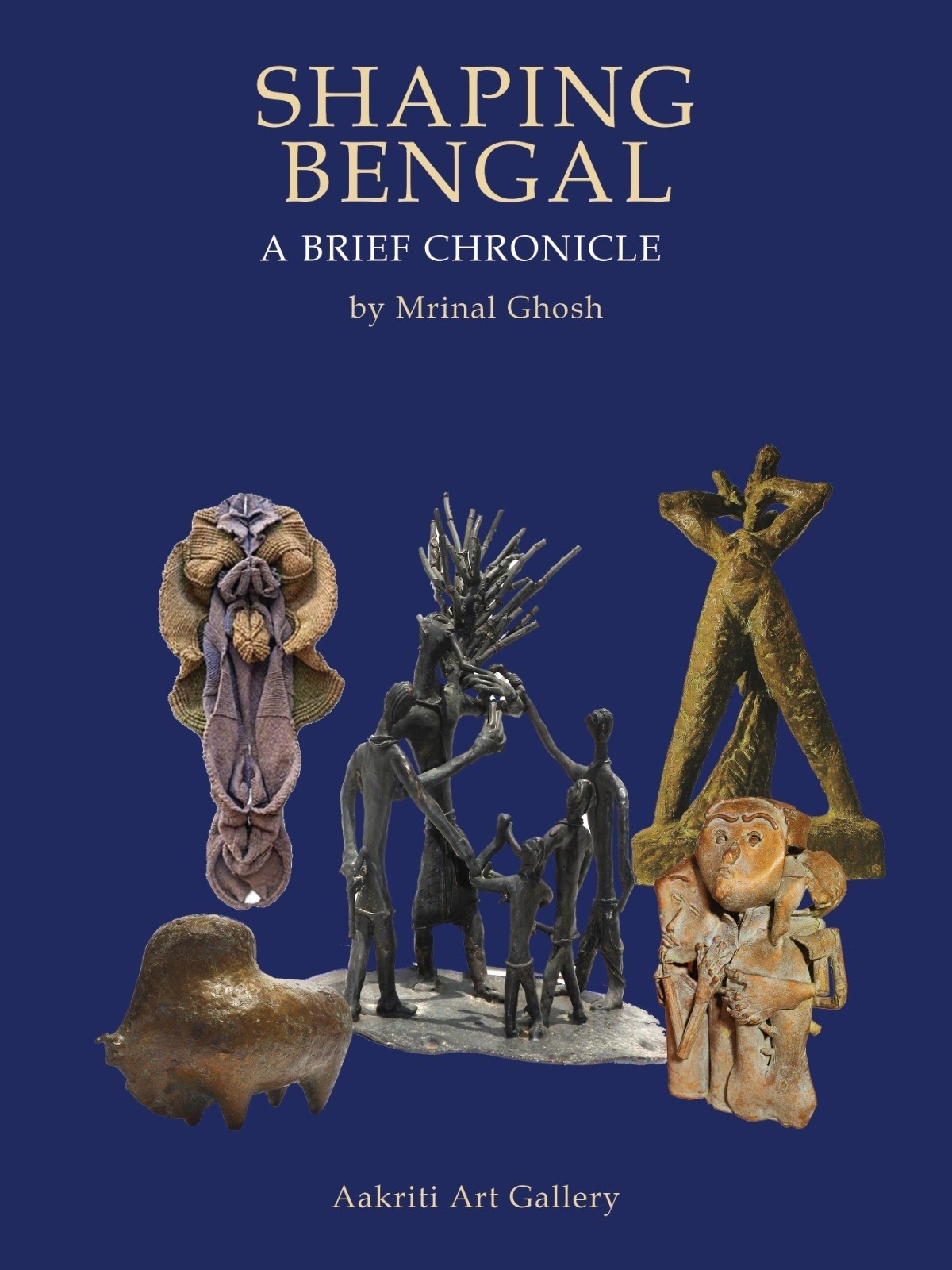
Shaping Bengal : A Chronicle of Modern Sculpture
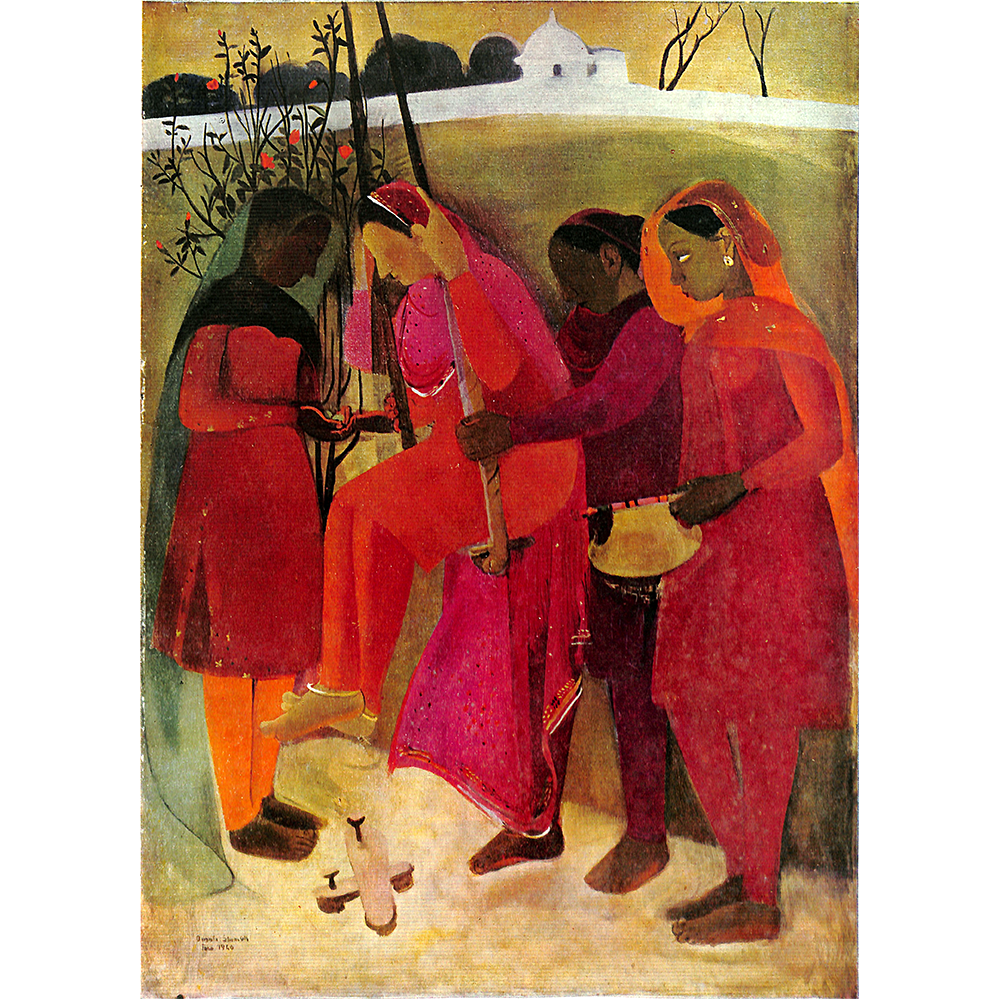
“Europe Belongs to Picasso… India Belongs Only to Me” || Why Amrita Sher-Gil Chose India as Her Artistic Destiny
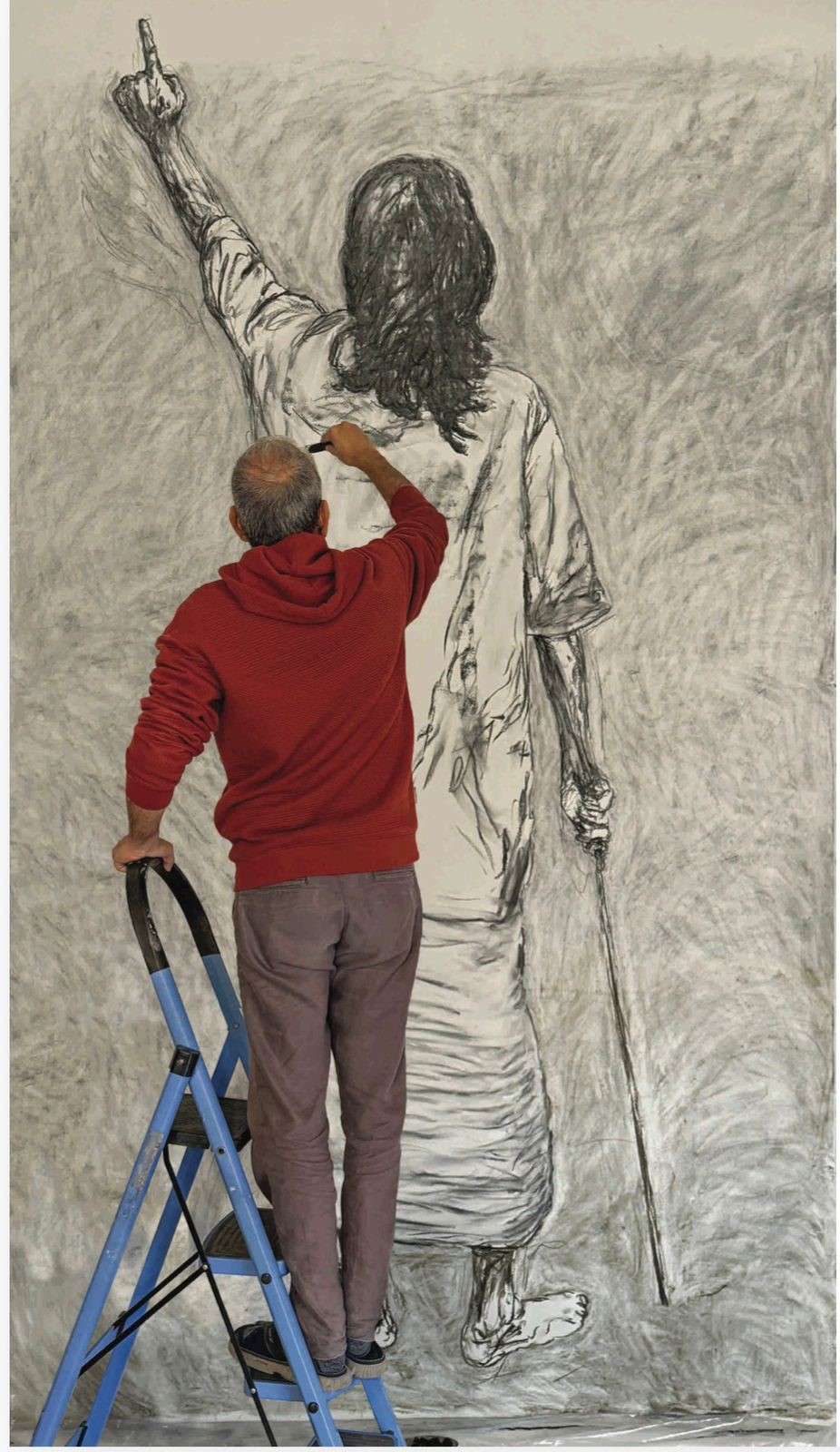
A Star Amongst Too Many: Chandra Bhattacharjee at Birla Academy of Art & Culture
The Indian Art Market Comes of Age
The Resurgence of the Indian Art Market
Comments
Join the Discussion
Please login to post comments.
Login